Get Free Ebook The End of Plenty: The Race to Feed a Crowded World
This The End Of Plenty: The Race To Feed A Crowded World belongs to the soft file book that we provide in this on-line website. You may find this kind of books and other collective books in this website actually. By clicking the link that we offer, you can go to the book site and enjoy it. Saving the soft file of this book becomes what you can overcome to read it everywhere. This way can evoke the break boredom that you can feel. It will also be a good way to save the file in the gadget or tablet, so you can read it any time.
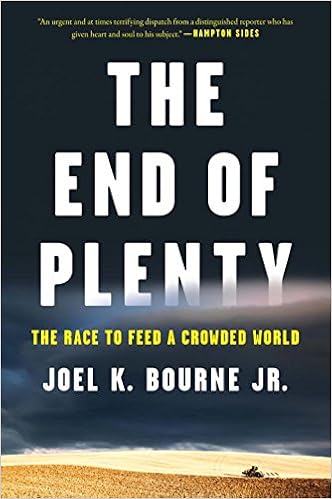
The End of Plenty: The Race to Feed a Crowded World

Get Free Ebook The End of Plenty: The Race to Feed a Crowded World
What to say and also what to do when primarily your good friends enjoy analysis? Are you the one that don't have such leisure activity? So, it is necessary for you to begin having that hobby. You understand, checking out is not the force. We make sure that reading will certainly lead you to take part better principle of life. Reviewing will be a favorable task to do every time. And also do you recognize our good friends come to be fans of The End Of Plenty: The Race To Feed A Crowded World as the very best book to check out? Yeah, it's neither a commitment nor order. It is the referred book that will certainly not make you really feel let down.
However, do you believe that reviewing publication will make you really feel burnt out? Occasionally, when you constantly read and complete guide quickly and hurriedly, you will certainly really feel so burnt out to spend many times to check out. Below, you can prepare for having only little time in a day or juts for spending your spare time. And guide that we come currently is The End Of Plenty: The Race To Feed A Crowded World, so it will certainly make some enjoyable for you.
Guide The End Of Plenty: The Race To Feed A Crowded World will consistently provide you good value if you do it well. Completing guide The End Of Plenty: The Race To Feed A Crowded World to read will not come to be the only goal. The objective is by obtaining the favorable value from guide till the end of guide. This is why; you should find out even more while reading this The End Of Plenty: The Race To Feed A Crowded World This is not just just how fast you read a book and not only has the amount of you finished the books; it has to do with just what you have actually acquired from guides.
You can locate the web link that we provide in site to download and install The End Of Plenty: The Race To Feed A Crowded World By buying the economical price and get finished downloading and install, you have completed to the initial stage to obtain this The End Of Plenty: The Race To Feed A Crowded World It will be nothing when having acquired this publication and also not do anything. Read it and disclose it! Spend your few time to merely review some sheets of page of this book The End Of Plenty: The Race To Feed A Crowded World to review. It is soft file and also very easy to check out wherever you are. Appreciate your new habit.
Review
“[A] fascinating narrative…Bourne brings a piercing eye to intransigent problems in food production and alleviation of hunger, leavened by notes of pragmatism and optimism.†- Jean L. Steiner, Science“An important read for everyone.†- Paul R. Ehrlich, co-author of The Dominant Animal“A thoroughly researched and exceptionally thoughtful and balanced look at the consequences of industrial farming. [Bourne's] book should convince every reader of the compelling need to address world food problems through more skillful and sustainable agronomy, but also through education, especially of women, and universal family planning.†- Marion Nestle, professor of nutrition, food studies, and public health, New York University, and author of Food Politics“Reading about the amazing advances being made by developing-world farmers with 'organic' agriculture left me with a vision of the planet we could still create.†- Bill McKibben, author of Deep Economy“One of the most informative, engaging books on the world food prospect I have ever read.†- Lester R. Brown, president of Earth Policy Institute, and author of Full Planet, Empty Plates“In a well-documented and fast-moving manner, Joel Bourne Jr., one of America's foremost experts by virtue of his 'hands-on' experience, education and world travel, clearly depicts a strategic challenge for America's national security in the coming years.†- Henry H. Shelton, General, US Army (retired), 14th Chairman Joint Chiefs of Staff“Joel Bourne, who grew up working on his family's farm, traveled the world to explore what may be the greatest challenge facing the next generation. The result is calm, lucid―and fascinating.†- Charles C. Mann, author of 1491 and 1493
Read more
About the Author
Joel K. Bourne Jr. has a BS in agronomy from North Carolina State University and an MS in journalism from Columbia University. A contributing writer for National Geographic, he has written for Audubon, Science, and Outside, among others. He lives in Wilmington, North Carolina.
Read more
Product details
Paperback: 416 pages
Publisher: W. W. Norton & Company; 1 edition (June 14, 2016)
Language: English
ISBN-10: 039335296X
ISBN-13: 978-0393352962
Product Dimensions:
5.5 x 1.1 x 8.3 inches
Shipping Weight: 1.8 pounds (View shipping rates and policies)
Average Customer Review:
4.4 out of 5 stars
36 customer reviews
Amazon Best Sellers Rank:
#245,464 in Books (See Top 100 in Books)
I thoroughly enjoyed reading this book.Lots of information that I have been previously exposed to as I am a voracious reader of science literature. Two important take aways for me were his explanation of Malthusian Theory and about unintended consequences. Bourne stresses, that its not the total amount of food relative to total population, but that the poor will feel the brunt of any overpopulation food shortages. No big surprise there, but its an issue that seems impervious to any viable solutions. Secondly, the production of food is complex and generally local. Miracle seeds, production methods, water availability, and a host of other factors can make for rapid and great improvements, but there usually is a quick plateau. And there always are some unintended consequences. Reading this book in an area where I have access to five supermarkets within a six mile radius puts an exclamation on his points.
I wanted to stick to the subject, I didn't need additional information on how this guy found another male so attractive, and I was amazed at how he went from discussing concerns over ground water to there's no proof Jesus actually exists. Weird asides like that kept this from being a complete work for me.
Nothing is more precious than balance, stability, and sustainability. Today, we’re hanging by our fingernails to a skyrocket of intense insane change, and it’s the only way of life we’ve ever known. Joel Bourne has spent his life riding the rocket. He grew up on a farm, and studied agronomy at college, but sharp changes were causing many farmers to go bankrupt. Taking over the family farm would have been extremely risky, so he became a writer for farm magazines. Later, he was hired by National Geographic, where he has spent most of his career.In 2008, he was assigned to cover the global food crisis, and this project hurled him into full awareness of the big picture. The Green Revolution caused food production to skyrocket, and world population doubled in just 40 years. Then, the revolution fizzled out, whilst population continued to soar. Demographers have told us to expect another two or three billion for dinner in 2050. Obviously, this had the makings of an excellent book, so Bourne sat down and wrote The End of Plenty.The subtitle of his book is “The Race to Feed a Crowded World,†not “The Race to Tackle Overpopulation.†A growing population thrills the greed community, and a diminishing herd does not. Overpopulation is a problem that can be solved, and will be, either by enlightened self-restraint, by compulsory restraint, or, most likely, by the vigorous housekeeping of Big Mama Nature. Feeding the current population is thrashing the planet, and feeding even more will worsen everything, but this is our primary objective. We are, after all, civilized people, and enlightened self-restraint is for primitive savages who live sustainably in roadless paradises.As incomes rise, the newly affluent are enjoying a more luxurious diet. To satisfy this growing demand, food production must double by 2050. “We’ll have to learn to produce as much food in the next four decades as we have since the beginning of civilization.†Meanwhile, agriculture experts are not bursting with brilliant ideas. “Producing food for more than 9 billion people without destroying the soil, water, oceans, and climate will be by far the greatest challenge humanity has ever faced.†Bourne’s book describes a number of gigantic obstacles to doubling food production — or even maintaining current production.Automobiles are more addictive than crystal meth. Europeans guzzle biodiesel made from palm oil. Americans are binging on corn ethanol. The 2005 Energy Tax Act mandated the addition of biofuels to gasoline. From 2001 to 2012, the ethanol gold rush drove corn prices from $1.60 to $8.28. Not coincidentally, in 2008 food riots erupted in twenty countries. The Arab Spring revolts began in 2011, a year of record harvests and record prices. Today, almost 40 percent of the U.S. corn crop is being fed to motor vehicles — enough corn to feed everyone in Africa. Experts predict that we’ll need four times more land for biofuels by 2030.Crops require cropland, and almost all places ideal for farming are already in use, buried under roads and cities, or have been reduced to wasteland. Every year, a million hectares (2.4 million acres) of cropland are taken out of production because of erosion, desertification, or development. So, 90 percent of the desired doubling in food production will have to come from current cropland. At the same time, the farm soils still in production have all seen better days. Agriculture is an unsustainable activity that normally depletes soil quality over time.Another obstacle is yield, the amount of food that can be produced on a hectare of land. Between 1961 and 1986, cereal yields rose 89 percent, due to the Green Revolution. But per capita grain production peaked in 1986. Since then, population has been growing faster than yields. Crop breeding experts are wringing their hands. A number of indicators suggest that we are heading for “agricultural Armageddon,†but the experts remain silent, praying for miracles. The biotech industry is focused on making huge profits selling seeds and poisons, not boosting yields.Agriculture guzzles 70 percent of the water used by humans. Irrigated fields have yields that are two to three times higher than rain fed fields. Demand for water is projected to increase 70 to 90 percent by 2050, but water consumption today is already unsustainable. “Over the next few decades, groundwater depletion could cripple agriculture around the world.â€Crop production is already being affected by climate change. Research indicates that further warming will take a substantial toll on crop yields. If temperatures rise 4°C, maybe half the world’s cropland will become unsuitable for agriculture. Rising sea levels will submerge large regions currently used for rice production.Meanwhile, population continues to grow, and some hallucinate it will grow until 2100. In a nutshell, our challenge is “to double grain, meat, and biofuel production on fewer acres with fewer farmers, less water, higher temperatures, and more frequent droughts, floods, and heat waves.†This must be done “without destroying the forests, oceans, soils, pollinators, or climate on which all life depends.â€Ladies and gentlemen, this is an outstanding book, and easy to read. Most people have blind faith that innovation will keep the supermarkets filled forever. Those who actually think a bit are focusing on stuff like solar panels, wind turbines, and electric cars. Food is something we actually need, and it gets far less attention than it deserves. By the end of the book, it’s impossible to conclude that everything is under control, and that our wise leaders will safely guide us through the storm. Surprisingly, a few additional super-threats were not discussed in the book.Bourne mentions that insects and weeds are developing resistance to expensive GMO wonder products, but stops there. Big Mama Nature is the mother of resistance. She never tires of producing new forms of life that are resistant to every toxin produced by science: insecticides, herbicides, fungicides, rodenticides, antibiotics. Every brilliant weapon we invent will only work temporarily. In terms of breeding new varieties of plants that are resistant to the latest biological threat, there are only so many tricks available. The low-hanging fruit has already been used. Just three plants enable the production of 80 to 90 percent of the calories we consume: corn, rice, and wheat.The global food system is heavily dependent on petroleum fuels, which are finite and nonrenewable. There is no combination of biofuels or alternative energy that will come anywhere close to replacing oil. In the coming decades, we will be forced to return to a muscle-powered food system. We are entirely unprepared for this, and the consequences will be very exciting for people who eat food.There is a similar issue with fertilizer. Of the three primary plant nutrients, reserves of mineral phosphorus will be depleted first, and this will blindside conventional agriculture — no phosphorus, no life. A hundred years ago, Chinese farmers used zero commercial fertilizer. Every morning, long caravans of handcarts hauled large jugs of sewage from the cities to the fields.In the end, readers are presented with two paths to the future. One path looks like a whirlwind of big trouble, and this is not just a comic book doomer fantasy — it’s already blowing and rumbling. The other path is happy and wonderful. Humans will discover their legendary big brains, turn them on, shift industrial civilization into reverse, speed down the fast lane to genuine sustainability, and live happily ever after. Place your bets.
a candid view of the world population growth and the limitation on yield growth. The author, without preaching, points out the changing landscape due to climate change and the relationship between food shortage, war, political instability, and migration. At the same time, he points out some places for hope like aquaculture which is dependent on finding ways to stabilize its relationship to weather. It should be a must read for those in political leadership who unfortunately have little time for reading because they're busy fundraising.
Fascinating and thought provoking view of the future of the planet. Detailed discussion and explanations of all aspects of food and feeding the world and how population will affect the outcome of everything.
As a non-agricultural person I found this book informative and easy to follow. The author is fairly balanced in his comments about the gains and ill effects on various techniques regardless of country.
I loved this book which takes the position that we have too many people to feed by 2050 and we must do it with fewer farmers, less acreage, not harming the environment or animals, with more droughts, less water, less pesticides and fertilizer, and we will fail. very interesting book and a good read.
This book is a great read. Mr. Bourne's writing style is captivating as he shares his information about the history of farming and feeding the world. The subject matter was much more interesting than I expected and really made me consider food options more carefully. The folks Mr. Bourne interviews are terrifically interesting too . I highly recommend this book!
The End of Plenty: The Race to Feed a Crowded World PDF
The End of Plenty: The Race to Feed a Crowded World EPub
The End of Plenty: The Race to Feed a Crowded World Doc
The End of Plenty: The Race to Feed a Crowded World iBooks
The End of Plenty: The Race to Feed a Crowded World rtf
The End of Plenty: The Race to Feed a Crowded World Mobipocket
The End of Plenty: The Race to Feed a Crowded World Kindle
The End of Plenty: The Race to Feed a Crowded World PDF
The End of Plenty: The Race to Feed a Crowded World PDF
The End of Plenty: The Race to Feed a Crowded World PDF
The End of Plenty: The Race to Feed a Crowded World PDF

This post was written by: Author Name
Your description comes here!

Posting Komentar