Ebook The Silk Roads: A New History of the World, by Peter Frankopan
Why ought to be this book The Silk Roads: A New History Of The World, By Peter Frankopan to check out? You will never ever get the knowledge and also experience without managing on your own there or trying on your own to do it. Thus, reading this publication The Silk Roads: A New History Of The World, By Peter Frankopan is needed. You can be great and appropriate sufficient to get how crucial is reading this The Silk Roads: A New History Of The World, By Peter Frankopan Even you constantly read by commitment, you can assist yourself to have reading publication behavior. It will certainly be so helpful and also enjoyable after that.
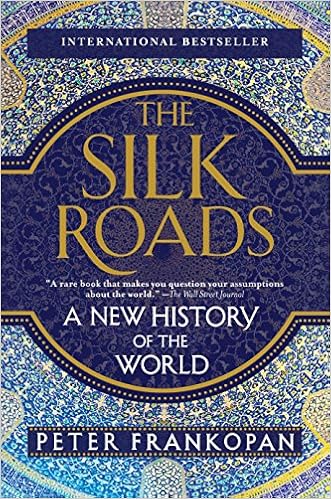
The Silk Roads: A New History of the World, by Peter Frankopan

Ebook The Silk Roads: A New History of the World, by Peter Frankopan
The Silk Roads: A New History Of The World, By Peter Frankopan. Welcome to the best site that available hundreds type of book collections. Below, we will certainly provide all books The Silk Roads: A New History Of The World, By Peter Frankopan that you require. The books from renowned writers as well as authors are offered. So, you could enjoy now to obtain one at a time sort of publication The Silk Roads: A New History Of The World, By Peter Frankopan that you will search. Well, pertaining to the book that you want, is this The Silk Roads: A New History Of The World, By Peter Frankopan your choice?
Positions currently this The Silk Roads: A New History Of The World, By Peter Frankopan as one of your book collection! Yet, it is not in your bookcase collections. Why? This is the book The Silk Roads: A New History Of The World, By Peter Frankopan that is provided in soft data. You can download and install the soft file of this amazing book The Silk Roads: A New History Of The World, By Peter Frankopan now as well as in the link provided. Yeah, various with the other people who look for book The Silk Roads: A New History Of The World, By Peter Frankopan outside, you can get simpler to pose this book. When some individuals still walk into the store and also browse the book The Silk Roads: A New History Of The World, By Peter Frankopan, you are right here only stay on your seat and obtain the book The Silk Roads: A New History Of The World, By Peter Frankopan.
Starting from seeing this website, you have aimed to begin loving checking out a publication The Silk Roads: A New History Of The World, By Peter Frankopan This is specialized website that offer hundreds collections of publications The Silk Roads: A New History Of The World, By Peter Frankopan from whole lots sources. So, you will not be tired anymore to choose the book. Besides, if you also have no time to search the book The Silk Roads: A New History Of The World, By Peter Frankopan, just rest when you remain in workplace as well as open the browser. You can locate this The Silk Roads: A New History Of The World, By Peter Frankopan inn this internet site by connecting to the web.
This is additionally one of the reasons by getting the soft file of this The Silk Roads: A New History Of The World, By Peter Frankopan by online. You may not require more times to spend to check out the e-book shop and also look for them. Often, you additionally do not find guide The Silk Roads: A New History Of The World, By Peter Frankopan that you are looking for. It will lose the moment. However right here, when you visit this web page, it will be so easy to obtain and also download the publication The Silk Roads: A New History Of The World, By Peter Frankopan It will not take often times as we mention previously. You could do it while doing another thing at residence or even in your office. So simple! So, are you question? Merely practice just what we provide here and also review The Silk Roads: A New History Of The World, By Peter Frankopan what you like to check out!
Review
“One of Mr. Frankopan’s gifts as a storyteller is his ability to draw unusual connections across his vast canvas . . . . Frankopan has written a rare book that makes you question your assumptions about the world.†—The Wall Street Journal “This provocative history challenges the view of the West as heir to a pure Greco-Roman culture. . . . Frankopan marshals diverse examples to demonstrate the interconnectedness of cultures, showing in vivid detail the economic and social impact of the silk and the slave trades, the Black Death, and the Buddhist influence on Christianity.†—The New Yorker “In his new book, The Silk Roads, Frankopan has created something that forces us to sit up and reconsider the world and the way we've always thought about it. . . . The book takes us by surprise right from the start.†—NPR “This is deeply researched popular history at its most invigorating, primed to dislodge routine preconceptions and to pour in other light. The freshness of . . . Frankopan’s sources is stimulating, and their sheer range can provoke surprising connections. He likes to administer passing electric shocks.†—Colin Thubron, New York Review of Books “This is history on a grand scale, with a sweep and ambition that is rare. . . . A remarkable book on many levels, a proper historical epic of dazzling range and achievement.†—William Dalrymple, The Guardian “A glorious read. . . . Frankopan is an exhilarating companion for the journey along the routes which conveyed silk, slaves, ideas, religion, and disease, and around which today may hang the destiny of the world.†—Vanity Fair “Dazzlingly rich and accessible. . . . By reorienting the history of the last few millennia to the east, and by resolutely keeping the camera rolling there, Frankopan unhooks us from the usual story of ‘Western Civ’ and gives us a startling and brilliant perspective on events that may once have been familiar—and plenty that aren’t.†—The Philadelphia Inquirer “Beautifully constructed, a terrific and exhilarating read and a new perspective on world history.†—History Today
Read more
About the Author
PETER FRANKOPAN is a historian based at Oxford University. He is the author of The First Crusade: The Call from the East, a major monograph about Byzantium, Islam and the West in the eleventh and twelfth centuries. He is a senior research fellow at Worcester College, Oxford, and the director of the Oxford Centre for Byzantine Research at Oxford University. His revised translation of The Alexiad was published in the United States in 2009.
Read more
See all Editorial Reviews
Product details
Paperback: 672 pages
Publisher: Vintage; Reprint edition (March 7, 2017)
Language: English
ISBN-10: 1101912375
ISBN-13: 978-1101912379
Product Dimensions:
6.1 x 1.5 x 9.1 inches
Shipping Weight: 1.8 pounds (View shipping rates and policies)
Average Customer Review:
4.3 out of 5 stars
475 customer reviews
Amazon Best Sellers Rank:
#3,132 in Books (See Top 100 in Books)
Author Peter Frankopan sets out, mostly successfully, to reorient our knowledge of history as taught in Europe and North America — history as viewed through the lens of Western Civilization courses. My quibble is that this is still a view of Central Asia though European eyes, and arguably the author pays slight attention to the history of ancient India and China and overplays the history of Central Asia and Western misconceptions of the Mongols.Frankopan’s main thesis is that the region stretching from the Mediterranean to China, and particularly the region that is now Iraq, Iran, and Afghanistan, remains the crossroads of civilization and the center of global affairs. As such, we need to understand ancient history and historical development over more recent centuries, as well as the way history is perceived by those in the region.The book proceeds chronologically. Chapter headings trace the many “silk roads†that have influenced global history, including the emergence and migration of major forms of religious faith, the rise and fall of empires at a time when Europe was an uncivilized backwater, and the role of trade as a conduit for the spread of ideas and wealth.We learn, for example, that the early expansion of Islam was benign. Often the major religions coexisted peacefully. Mohammed and the Jews needed each other as both repudiated Jesus as the Messiah. In Damascus, churches were untouched even as Islam became the religion of the majority. Only after divisions began to develop in Islam did attitudes harden toward other religions, says the author.Western Europe in the 600s and 700s was barbaric, while Baghdad was at the height of its wealth and academic achievement. Thus, traders and intellectuals along the Mediterranean were oriented toward the East, not Western Europe. Among conventional beliefs that Frankopan seeks to puncture is the notion that the Mongols were chaotic. Instead he says they were good bureaucrats and operated as a meritocracy. Terror was applied selectively but was broadcast broadly as a tool of coercion. The result was to control wealthy territories with a minimum of effort.As Elizabethan England competed with Spain, says the author, there was an opportunistic alliance with the Muslim world against a common enemy. Both the English and the Moors engaged in piracy against the Spanish and Portuguese. The English freed Muslims who had been “galley slaves†and returned them home, and had Muslim support for the 1596 attack on Cadiz. Shakespeare portrays positively the Moor in Othello and Persia was also characterized favorably in English literature of the time.By the late 18th and early 19th Century, however, the power relationship between rising Western European powers and Persia and neighboring countries had been reversed. India became a crown jewel in the British Empire and the British became preoccupied with fear of Russian expansion into Persia. Misunderstandings were rife. “The British cannot say what they mean and the Persians do not mean what they say,†noted one observer.In the aftermath of World War I, the British created Iraq out of Mesopotamia, arbitrarily combining a hodgepodge of nationalities. As oil was discovered in Iraq and Iran, the British moved quickly to exploit these resources and minimize the royalties that were paid to the nations from which oil was extracted. Dissatisfaction with British oil companies resulted in a greater role for American oil companies, but the exploitation of the region changed little until OPEC was formed.The final 40% of the book is devoted to British and American ignorance and arrogance in the 20th and 21st Centuries, resulting in the support of the Shah in Iran, Saddam Hussein in Iraq, and Ayub Khan in Pakistan among others. Frankopan characterizes British, then American strategy as “solving today’s problems without worrying too much about tomorrow’s problems.â€This is useful background for anyone trying to understand the resentment felt in Iraq and Iran toward the West today.As Frankopan looks forward, there is little analysis of the potential role of China in the balance of power that could shape the region’s future or of India whose population and economy are among the world’s largest and fastest-growing.Instead, with an emphasis on what was once known as Mesopotamia, the author asserts that, “the Silk Roads are rising up once more.†Events that appear chaotic instead are the “birthing pains of a region that once dominated the intellectual, cultural and economic landscape of the world…We are seeing the signs of the world’s centre of gravity shifting — back to where it lay for millennia.†This seems an optimistic analysis.In sum, the value for many readers will be found in the first half of the book, as a balance to the history taught in the West. The resentments held in the region toward American and British influence are the result not just of recent decades but of exploitation taking place in the past 100 years. Oddly, though, the author’s contemporary assessment of the region seems viewed through the same Western lens that he criticizes as having warped our understanding of the past.
I was very disappointed after reading all the wonderful reviews. Maybe they are reading a different book? I had assumed we would be learning about the history of the silk roads and the many dynasties that rose and fell along the route - the Songdians, the cities of the Tamir Basin for example. I thought this would be an Asian centric book showing the silk roads impact on Han Dynasty China and the steps that had to be taken to keep the route secure. I thought we would learn of the earliest use of the silk road in trade between Sumeria and what is now northern Afganistan based on the early trade in Lapis and how this led to the later creation of Faience. Or perhaps how the silk road brought Buddhism to the west and mixed the artistic sense of the descendants of Alexander's army with the Central Asian Buddhist cave dwellers. I was very wrong in my expectations.Maybe I am missing something but this is still a Western-centric view, centered on Byzantium and medieval Europe. The first steppe dwellers we meet in any depth are the Mongols, who by that time, are a thousand years later than the early steppe dwellers who so profoundly influenced world culture both East and West. This book spends most of it's time in detailing the trade and fortunes of the West instead of focusing on the various kingdoms of the silk road. What is going on here? How could all the reviewers have missed this? This book is not as advertised a new history of the world, but rather a view of the economic impact of trade on the western world. For example, how does Columbus come to bear on the silk road? We read here about his expedition but no analysis relating to the silk road at all. That is one of many examples to show that the author does not seem to have much interest in writing about the silk road, but rather about how luxury good trade impacts the western world.This is my first book review although I have read dozens that I may not like. I am only writing this because it is not that I do not like what is written, but rather it is not what the book title implies and I want to give fair warning to others who may be like me in their interests.
“The Silk Roads†is a wonderful invigorating work of history. It is directed to the general reader rather than the specialist. I found it be absolutely riveting.The essence of the book is that, in the West, our history is viewed through a very narrow lense. Schools teach its students of the Roman Empire, the subsequent Dark Ages, the Norman conquest in 1066, Henry VIII and the Tudors, the American War of Independence, the Industrial Revolution and the First and Second World Wars. The vast bulk of a map of the world from western Europe to China is passed over very quickly. With “The Silk Roadsâ€, Peter Frankopan has attempted to redress this imbalance.As the author states:“For centuries before the early modern era, the intellectual centres of excellence of the world, the Oxfords ad Cambridges, the Harvards and Yales, were not located in Europe or the west, but in Baghdad, and Balkh, Bukhara and Samarkandâ€.Moreover, Frankopan gives the reader a perspective on the rise of Mesopotamia, Alexander the Great, the rise of Christianity in the eastern Roman Empire and then the subsequent rise of Islam throughout much of Asia. He then proceeds to discuss the Crusades, the rise of Genghis Khan and his mighty Mongol Empire and then the rise of China more specifically. He concludes by bringing the book up to the present day with the rise of Europe and the USA before suggesting that there is a reorienting of history underway again. In other words:“we are witnessing…the birthing pains of a region that once dominated the intellectual, cultural and economic landscape and which is now re-emerging. We are seeing the signs of the world’s centre of gravity shifting – back to where it lay for millenniaâ€.Whether you agree or not with Peter Frankopan’s conclusions, the book remains a tour-de-force. Thoroughly recommended.
The Silk Roads: A New History of the World, by Peter Frankopan PDF
The Silk Roads: A New History of the World, by Peter Frankopan EPub
The Silk Roads: A New History of the World, by Peter Frankopan Doc
The Silk Roads: A New History of the World, by Peter Frankopan iBooks
The Silk Roads: A New History of the World, by Peter Frankopan rtf
The Silk Roads: A New History of the World, by Peter Frankopan Mobipocket
The Silk Roads: A New History of the World, by Peter Frankopan Kindle
The Silk Roads: A New History of the World, by Peter Frankopan PDF
The Silk Roads: A New History of the World, by Peter Frankopan PDF
The Silk Roads: A New History of the World, by Peter Frankopan PDF
The Silk Roads: A New History of the World, by Peter Frankopan PDF

This post was written by: Author Name
Your description comes here!

Posting Komentar