PDF Download
From the combo of knowledge and also actions, a person can boost their skill and also ability. It will certainly lead them to live and also function better. This is why, the students, employees, and even employers need to have reading practice for books. Any type of publication will certainly provide particular expertise to take all advantages. This is what this tells you. It will certainly add even more expertise of you to life and also function better. , Try it and prove it.

PDF Download
Interestingly, that you truly wait on now is coming. It's significant to wait for the agent as well as helpful publications to review. Every publication that is supplied in much better means and utterance will be anticipated by many individuals. Also you are a great reader or not, really feeling to read this book will always show up when you discover it. But, when you feel hard to discover it as yours, just what to do? Obtain to your close friends and also have no idea when to repay it to her or him.
Why need to be publication Book is among the very easy resources to look for. By obtaining the author and also motif to get, you could discover numerous titles that provide their data to obtain. As this , the motivating publication will certainly offer you just what you need to cover the task due date. And also why should remain in this website? We will certainly ask initially, have you a lot more times to opt for going shopping the books as well as hunt for the referred book in book store? Lots of people could not have enough time to discover it.
As known, book is a very good resource to take when you are preparing to do something, having problem to resolve, or having job for due date. It can be a buddy for you to invest the moment beneficially. Promo concerning this publication has been in different means. As below, we provide you're the because it really provides amazing system of someone to read it.
Yeah, reviewing a publication could add your buddies listings. This is just one of the solutions for you to be successful. As understood, success does not indicate that you have fantastic things. Recognizing and also understanding greater than various other will certainly give each success. Close to, the message and also impression of this can be taken as well as picked to act.
Product details
File Size: 5738 KB
Print Length: 320 pages
Publisher: CQ Press; 5 edition (June 22, 2016)
Publication Date: July 5, 2016
Sold by: Amazon Digital Services LLC
Language: English
ASIN: B07D51KMSF
Text-to-Speech:
Enabled
P.when("jQuery", "a-popover", "ready").execute(function ($, popover) {
var $ttsPopover = $('#ttsPop');
popover.create($ttsPopover, {
"closeButton": "false",
"position": "triggerBottom",
"width": "256",
"popoverLabel": "Text-to-Speech Popover",
"closeButtonLabel": "Text-to-Speech Close Popover",
"content": '
});
});
X-Ray:
Not Enabled
P.when("jQuery", "a-popover", "ready").execute(function ($, popover) {
var $xrayPopover = $('#xrayPop_C990A6765BBF11E982BD262CF0E5EE70');
popover.create($xrayPopover, {
"closeButton": "false",
"position": "triggerBottom",
"width": "256",
"popoverLabel": "X-Ray Popover ",
"closeButtonLabel": "X-Ray Close Popover",
"content": '
});
});
Word Wise: Enabled
Lending: Not Enabled
Screen Reader:
Supported
P.when("jQuery", "a-popover", "ready").execute(function ($, popover) {
var $screenReaderPopover = $('#screenReaderPopover');
popover.create($screenReaderPopover, {
"position": "triggerBottom",
"width": "500",
"content": '
"popoverLabel": "The text of this e-book can be read by popular screen readers. Descriptive text for images (known as “ALT textâ€) can be read using the Kindle for PC app if the publisher has included it. If this e-book contains other types of non-text content (for example, some charts and math equations), that content will not currently be read by screen readers.",
"closeButtonLabel": "Screen Reader Close Popover"
});
});
Enhanced Typesetting:
Enabled
P.when("jQuery", "a-popover", "ready").execute(function ($, popover) {
var $typesettingPopover = $('#typesettingPopover');
popover.create($typesettingPopover, {
"position": "triggerBottom",
"width": "256",
"content": '
"popoverLabel": "Enhanced Typesetting Popover",
"closeButtonLabel": "Enhanced Typesetting Close Popover"
});
});
Amazon Best Sellers Rank:
#577,381 Paid in Kindle Store (See Top 100 Paid in Kindle Store)
I got this for my American Legislative Process class. This version is older than the one my professor required. Ooops. It's THE authority on lawmaking, but rather boring. Even my professor tended to find news articles for our class to try to make it more engaging.
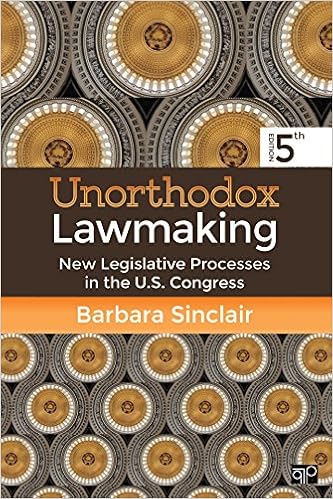
If you're interested in knowing how the legislative process does or does not work, Barbara Sinclair's Unorthodox Lawmaking is a must read series.Unorthodox Lawmaking: New Legislative...
A great book!
Good Stuff
There exists a profound difference between the legislative process observed on Capitol Hill and the legislative process described in most U.S. Gov't textbooks and Sinclair's work presents a fluid and well written testament to that fact!In her preface, she explains that this work was written to help the most nascent student of Congress understand the legislative process, but I would say those without a working knowledge of Congress will not appreciate the nuances in this work.Sinclair compares historical and even for their time, controversial legislation (Clean Air Act) with the more modern examples of legislation that proved out signficantly more problematic than their earlier counterparts. Moving back and forth between the House and the Senate, she begins to paint the picture of the divisiveness that is partisan politics today.That Sinclair would write such an ambitious work, is a tribute to her understanding of this body. This book is sophisticated and insightful and should be on the shelves of EVERY student in political science, but particularly those who study Congress.I would add this disclaimer however, that this book is not for the faint of heart. If one has already developed an abiding mistrust in Congress, this book may only serve to reinforce it. The simple fact is, if more people were exposed to the true nature of "doing the business of the people," they would appreciate the "ugliness of democracy" and embrace it for that! Three cheers to Barbara!
In her book, Unorthodox Lawmaking: New Legislative Processes in the U.S. Congress, Barbara Sinclair successfully argues that legislation no longer follows the common "textbook method." Representatives and senators alike have adapted new methods, sending each bill through a different custom-tailored process. Though she leaves a few questions unanswered, Sinclair uses multiple forms of research to paint a clear picture of how legislation is now passed.Sinclair divides the book into three sections - first analyzing the path bills take, then exploring how and why these processes developed, and finally making an in-depth analysis of these changes through several case studies.The House, she argues, has grown more efficient through this developmental process. The leadership has seized power through a variety of rules and other manipulations. By shipping bills to what committee it wants (or, in some cases, committees), the leadership can put bills in friendly hands. Post-committee changes make bills passable, and finally the leadership can use rules to craft debate exactly how it wants.In the Senate, the opposite has happened. Senators have used new methods to gain individual power. Most importantly, Senators have often use filibusters, both covertly and overtly, to prevent the majority from getting its way. The need for a 60 person majority gives a minority senator incredible power.After this analysis, Sinclair then turns to examine how these changes came about. She suggests that opportunity and necessity drove the changes. As parties became more polarized and constituents demanded more efficient legislation, the Senators looked for ways to outsmart and out manipulate the other side. Ultimately, Sinclair argues that these processes have made passing legislation more efficient. Significant legislation has passed more often when such measures have been applied.Proving any thesis, including this one is a difficult task. Some books, including the Jacobs/Shapiro book and the Fenno book, lack a strong backbone because they rely on only one method of research that each have obvious shortcomings. Sinclair avoids this mistake, opting for a variety of research methods that paint a broad and tightly constructed picture.The first method Sinclair turns to is statistical data. Multiple charts confirm Sinclair's argument that the legislative process is becoming more complex. Figure 5.1 notes a distinct and obvious trend towards the use of more special maneuvers. Later figures confirm these trends (at least to a degree) in the Senate.As evidenced in Jacobs and Shapiro, statistical evidence does, however, have its limit. Sinclair successfully researches history and changing political dynamics to explain the statistics, not leaving them to stand on their own ground. Of course, this method has its drawbacks. The reader is forced to accept Sinclair's interpretation and conclusions. Nonetheless, there is no better method to interpret the data, and Sinclair seems to have done her homework, presenting a thoughtful and well researched chapter.Finally, Sinclair uses another method to bring her point together. Standing alone, case studies do not pass muster; they are simply too narrow to make broad generalizations. When taken in the context of statistical data and interpretations, however, they effectively bring the numbers to life. Sinclair starts by examining the National Service Bill. She highlights a more or less traditional process. The reader does, however, see several uses of non-traditional methods, particularly in the Senate, where a filibuster threat and a non-germane amendment give the minority quite a voice. By the time the Omnibus Health Bill was passed, Sinclair describes a process that was completely different. The bill is sculpted and directed at every turn. The reader sees a clear difference from the first case study to the last.Using these methods, Sinclair does paint a convincing picture. However, she leaves some notable holes. The first concerns the role of the President in the legislative process. In her initial analysis (chapters 1 through 5), she considers the president only briefly, mentioning his veto power and the occasional need for a summit. Surely, the president's role is not limited to a brief meeting. From reading the case studies, it becomes obvious the president is often influential, even a driving force in legislation. Why is the president's role essentially ignored in her descriptive analysis?Sinclair's ultimate conclusion is that "unorthodox lawmaking" makes legislating more efficient, but she seems to recklessly add that legislation will now "reflect the will of the people." Through examination of this book, I have encountered scant evidence that would suggest this to be true. The new tools are used to overcome the power of the opposing party; how this reflects public opinion is not seriously addressed.In fact, Sinclair offers little proof that new legislative processes have significantly increased responsiveness to the general public. By making this statement, Sinclair opens a whole new set of inquiry about the dynamics of public opinion and the influence of outside interests. Unfortunately, she can not substantiate any claims in this area. An interesting addendum to this book might include an analysis of how closely legislation's relation to public preference has changed as these processes developed. Another addendum might include an inquiry into how the public sees these processes. Does it further the view that the Congress is simply power driven and unresponsive?Despite these minor shortcomings, Sinclair nonetheless proves her point. Congress today is a different body than it used to be several decades ago. Legislation no longer follows the textbook method on its way to becoming law. Instead, it takes many different paths and contours, contours that help promote its passage. Unorthodox Lawmaking is a piece of sound research that describes an evolving process.
I had to read this book for a course on the Legislative Process. While it is definitely readable, and well-researched, it is expectedly dry. Sinclair describes methods that are becoming more common in getting major legislation passed, and shows that this unorthodoxy is not necessarily a bad thing. The first half of the book describes the changes that the system has undergone, while the second half illustrates how these methods affected several major bills. Examples include a national service bill, regulatory overhaul, an omnibus drug bill, and two budgets.
I was really hoping to receive the words of this particular text in book form, and that's exactly what I received. This seller is gracious enough to have shared this product with me. I can read it any time I want. There it is right now, sitting at the foot of my bed. I could hold it if I wanted.Thank you, seller.
PDF
EPub
Doc
iBooks
rtf
Mobipocket
Kindle

This post was written by: Author Name
Your description comes here!

Posting Komentar